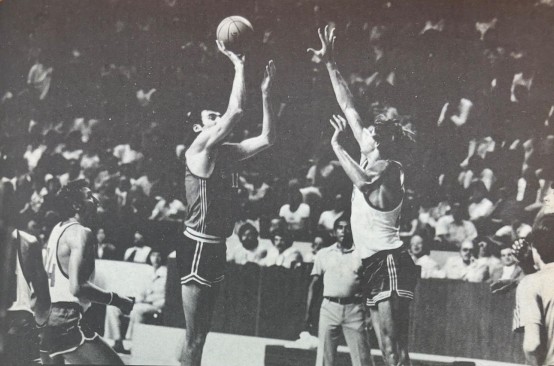
Everywhere on earth, Krešimir Ćosić — basketball's foremost cosmopolitan — has continued to wage fierce battles against the best rivals around. Now the time has finally
come for him to hang up his shoes and start giving instructions from the bench. So now, let's open up his life, one filled with turbulence and glory. BYU had one of the highest average attendances in America (around 21,818 spectators), and Ćosić was the player who most delighted those crowds — among the most popular in Cougars history. This Croatian from Zadar, Yugoslavia (a country in Central Europe and the Balkans which existed from 1918 to 1992), was a bundle of sheer drive: an unusual 211cm center who played almost like a guard, yet still got the job done — averaging 22.3 points and 13 rebounds a game, leading fast breaks, throwing behind-the-back dribbles, and pulling off wild shots. This is how the American basketball magazine Street & Smith's described BYU All-American Krešimir Ćosić in 1972.
Few players in basketball's long history have led a life as extraordinary as Ćosić's. Born in the old Croatian city of Zagreb, he grew up in the Dalmatian port town of Zadar. He made the national team at just 16, competed in the 1968 Mexico City Olympics at 19, and the following year went to study at BYU in Utah. Rather than merely "fitting in," he became an All-American outright. Before graduating he was drafted by the NBA's Los Angeles Lakers, but skipped tryouts and returned home instead — transforming his hometown club Zadar into Yugoslavia's strongest team almost overnight, while becoming a mainstay of the national team. In the late '70s he played two seasons in Italy, leading his club (Bologna) to the national title both years. He was also a driving force behind Yugoslavia's championship at the 1978 Manila World Championship and the 1980 Moscow Olympics.
Among his memorable moments: swatting down a jump shot from Sergei Belov (USSR), ripping a rebound away from Carlos Capelão (Brazil), shutting down Dino Meneghin (Italy) with a wall-like screen, dunking over the top of Stanislav Kropilák (Czechoslovakia), and shaking off Adrian Dantley (USA) to sink a jumper.
Everywhere on earth, this man has always fought against the very best. Eventually, even basketball's foremost cosmopolitan had to take off his shoes. But the
previous year, after leading his club Cibona Zagreb to the Yugoslav title, Ćosić left the hardwood battlefield behind. Fans not just in Yugoslavia but around the world couldn't hide
their sense of loss at his retirement — everyone felt, in their bones, that an era had truly ended.
And yet — he came back to the basketball world.
The author could not hide his joy and surprise upon discovering Ćosić’s name listed as head coach of the Yugoslav national team for the Kirin World tournament, held in Tokyo in
the summer of 1984. I requested an interview immediately and waited eagerly for the day to arrive — not only to learn about Ćosić's turbulent, glorious life, but to share a bygone era together.
"Homesick? I Never Had Time for That."
I first encountered Ćosić in person courtside at Tokyo’s Yoyogi Gymnasium No. 2 on the final day of the Kirin World tournament. He had a striking presence — bespectacled,
suited, quiet and intellectual, almost like a "philosopher" courtside, which alone drew attention. But once the game began, he'd bellow encouragement to his young players loud
enough to be heard throughout the arena, stamping his feet in frustration at mistakes, his Slavic blood running hot without restraint. A true courtside "Dr. Jekyll and Mr. Hyde" — and it seemed basketball itself was the powerful drug that turned this philosopher into a madman.
After the game, seated before me in a hotel room, Ćosić had reverted to his scholarly demeanor — Mr. Hyde back in his silk hat. His deeply lined, finely sculpted 36-year-old face carried a calm, deep smile. Having interviewed many basketball players, it's rare to meet someone where just a word or two face-to-face gives you the immediate sense of "ah, this one's the real deal." Ćosić delivered exactly that rare impression — the kind of authentic presence built only after years of accumulated ease, confidence, and gravitas, fermented further by a taste of life's hardships. The author has only known a few other men with that same quality — John Havlicek, Kareem Abdul-Jabbar among them.
My own theory: this kind of stature can never come from simply running hot-blooded. It comes, rather, from how someone confronts what wells up inside them once they've
calmed and quieted that fiery blood. Heroes are often men of few words — but their presence speaks louder than words ever could.
I asked Ćosić to start by talking about his experiences in America, where he lived from 1969 to 1973.
Q: America — it must already be hard enough for a young Yugoslav to head off to this country alone, but you chose Brigham Young University, a rather unusual place even by American standards (a Mormon school with many devout students and faculty). Why was that?
A: At a tournament, I met a Finnish player who had once played at BYU, and he introduced me to a BYU recruiter (Bob Peterson). Eventually letters of invitation started arriving from BYU, and they offered me a scholarship. All I really knew about BYU was that it was "big" — but that didn't matter much to me. A big school was bound to have a strong team. What mattered more was that I wanted to go alone. I had a strong urge to get away from the coach who'd been by my side constantly for so long. Provo, where BYU was located, was a college town a bit removed from the state capital, Salt Lake City. It was nothing like Europe, but the first year anywhere is tough no matter
where you are. Being a basketball player probably helped me adjust faster.
Q: Did you ever get homesick?
A: I never had time for that (laughs). Back then I'd play in America for seven and a half months, then return to Yugoslavia for the other four and a half — the summer — to play for the national team. It was a hectic life. Whenever I got tired of America, I'd go to Europe, and whenever I got tired of Europe, back to America — it worked out perfectly (laughs).
America is an easy country to adapt to. It's not bound up in old customs the way Europe is. If I were alone in my room, an American student might suddenly walk in, flop down on my bed, and start chatting away. Nobody does that in Europe. In Europe, we are much more open and easygoing. Eventually I even came to believe in the Mormon faith. I adapted quickly.
Q: What did you study at school?
A: At first, physical education — I couldn't even speak English, so there wasn't much choice. Later I majored in business, but I never managed to get the credits needed to
graduate, since every year I had to return to Yugoslavia by May 1st before national team practice began. While at BYU I still competed in international tournaments — the World
Championship in Ljubljana, the European Championship in Essen (East Germany), the Munich Olympics, and the European Championship in Barcelona.
Q: Didn't your time in America have a big impact on your personality?
A: I think so... I became better at expressing my own opinions clearly. And of course I learned a lot about basketball. I also learned how to balance academics with sports —
something I simply hadn't been able to do before going to America (laughs). After returning to Yugoslavia, I kept playing while attending university and earned degrees in English and Italian in just two years — that, too, came from good habits I picked up in America. When you're competing in international tournaments from age 16 onward, it's hard to develop study habits — back then I was playing around 120 games a year.
Q: Zagreb, where you were born and still live, is an old European city, far from America's influence. Do you retain any "American" traits even living there?
A: I don't think of myself as particularly "American," but apparently that's not how others see it. Friends sometimes tell me a certain gesture of mine looks "just like an American." I still go back to America whenever I get the chance, to see old friends.
Yugoslavia is often called a "mosaic nation" for its ethnic diversity — over a dozen major
ethnic groups. In addition, there are Italians who cluster in the north, Turkish populations in the south. The country is so fragmented that it doesn't even have a single official language; different republics and regions use different tongues (Yugoslavia is a federation of six republics and two autonomous provinces). There's even a well-known rhyme about it:
Yugoslavia made of six republics, home to five nations, speaking four languages, believing in three religions, using two alphabets — yet one single country.
The Republic of Croatia, where Ćosić was born and raised, was under Austrian rule for nearly four centuries, and has a strongly Western European, predominantly Catholic
character. Serbo-Croatian, a Slavic language, is spoken there. Its capital, Zagreb, is nicknamed "Little Vienna," and indeed boasts charming streets lined with cafés and an
elegant cathedral. Its people carry that signature Slavic warmth. His eyes radiate vitality. He loves humor, and to a hard-headed Japanese person, it would be hard to tell where his seriousness ends and his joking begins. Zadar is a port town on the Adriatic Coast, strongly influenced by Italy across the water.
Blessed with endlessly blue seas and a fiercely strong sun, its people have the enviable pleasure of sipping wine while feeling the sea breeze at night.
Talking with Ćosić, these scenes of Yugoslavia vividly came back in my mind, and having visited Yugoslavia twice myself, I found my gaze drifting far away toward those memories. He had many of the qualities so characteristic of Yugoslav people — the warm, open Slavic smile, an unpretentiousness, and disarming straightforwardness.
But glimpses of Ćosić the internationalist could be clearly seen not just in his fluent (if slightly accented) English. The candor that lets him talk easily with people of any
nationality, and the breadth, depth, resilience, and flexibility of spirit needed to maintain, protect, and assert one's own identity wherever one goes — these aren't things you pick up just by living briefly in one or two countries. Through basketball, Ćosić learned to turn his gaze toward the distant red-tiled roofs of Zagreb.
"American Players All Play the Same Way"
Ćosić spoke slowly, one point at a time, in a low voice. Perhaps out of consideration for the tape recorder picking up his voice, he leaned forward in his chair, hands clasped between his knees, speaking unhurriedly. It was a far cry from the image of him courtside, looking ready to blow steam out of the top of his head. When he heard the words "Yugoslavia" or "Zagreb," his eyes would narrow and the corners of his mouth crinkle into a smile that carried a warmth inviting you to breathe a sigh of relief.
I'll say it again: even among those called basketball stars, few possess a presence like the calm sea: gentle yet powerful. Among the players I've interviewed in the past, it's far more common to encounter someone who uses "you know" once or twice in a single sentence without seeming to know what they're saying themselves, someone who can only answer in monosyllables like "yes" or "no," someone who bristles at every question, or someone so consumed with protecting their own ego that they have no attention left for anything else.
The interview with Ćosić continues.
Q: Let's move to basketball. Did you make the starting lineup right after enrolling at BYU?
A: Back then, most NCAA conferences had a rule that freshmen couldn't play varsity. So I had to spend my first year on the "freshman team." On top of that, I overplayed and came down with a jumper's knee — there were times my knee hurt so badly I couldn't even walk. Once I became a sophomore and my knee recovered, I became a starter right away. I was selected to the WAC (Western Athletic Conference) All-Conference first team for three consecutive years until graduation — I'm told only three other players besides me have achieved that record.
Q: At the time, the WAC had many well-known players: Jim Forbes of UTEP (198cm, Forward, who competed in the Munich Olympics) and Mike Sojourner of Utah (203cm, Forward, later with the NBA's Chicago Bulls), among others. Do you feel you competed with them on equal footing?
A: They never troubled me. I beat them in both experience and height. My defense still had room to improve, but on offense no one could stop me, and I could grab rebounds at will. If I'd put my mind to it, I could easily have pulled down 15 to 20 rebounds in a game. If anything, I'd say it was them who were troubled by me (laughs). The Americans’ playing style was all the same. So when a player like me came along, different from them, they probably couldn't handle it. For example, they'd catch a pass and
immediately turn to face the basket and start moving toward it. In my case, sometimes I'd face the basket, but other times I'd fake and go in a different direction.
Back then, I think European centers were generally more skilled than American centers — though of course now it's the opposite, and that's true for Yugoslavia too. European centers in that era were point-getters. Now they're just jumpers chasing rebounds.
Q: An American magazine wrote that "Ćosić doesn't play like a center, he plays like a guard." Do you think that's an accurate comment?
A: Well... when I first started playing basketball I was a guard, and offensive skills like passing and dribbling came completely naturally to me — I also liked shooting from the
outside. Since the lane would open up to the basket, I could cut in myself or pass to a teammate. It was far more interesting than just hovering around the basket — it was
genuinely my natural playing style.
This account from Ćosić struck me as a real eye-opener. Here was a young man barely twenty, arriving from a remote corner of Yugoslavia in the 1970s, who looked at America's globally dominant basketball and laughed it off as "everyone plays the same way" — then proceeded to outplay America's battle-hardened stars from cities as tough as New York and Los Angeles and earn All-American honors. I found this both delightfully satisfying and genuinely surprising.
On reflection, it's true that no center like Ćosić existed in America before he arrived — a tall player who dashed all over the court, led fast breaks, threw behind-the-back passes and dribbles, sank shots from absurd distances, and could also blow past a slower opposing center to cut to the basket. Even basketball's most advanced nation didn't yet have a center like that. The year after Ćosić enrolled at BYU, Dave Cowens (205cm), who joined the NBA's Boston Celtics from Florida State, became an early example of this "new kind of center" — one who could run the floor and shoot from the outside. Two years later, Bob McAdoo (206cm), who went from North Carolina to the NBA's Buffalo Braves, followed in Cowens' footsteps. These kinds of players are no longer unusual at all — but back in 1969, when Ćosić arrived in America alone, centers like that simply didn't exist yet. It might be an overstatement to call Ćosić the one who lit the fuse, but it's certain Americans had never seen a center play the way he did — and their bewilderment came out as the label "a center who plays like a guard."
What an inspiring story.
Q: During your time in America, was there a player you particularly admired?
A: My biggest hero was always Bill Russell (208cm, Center). Before coming to America I had only been an offensive player, but he was a star on both ends of the floor, and I admired players like him who always won. Winning is still the most important thing to me, even now.
I doubt there's a player anywhere who's tasted as many wins as I have. Whether you score 5 points or 40, it means nothing if you don't win. I play first to win, then for the fans, and then for myself.
Q: Just two years ago, in '81, you led Cibona Zagreb to the Yugoslav title, defeating Partizan Belgrade — the team with Dražen Dalipagić (198cm, Forward) and Branko Skroče (185cm, Guard).
A: Zadar won the national championship five times while I was there, and in Italy too, my team won the national title twice. At Zadar, where I started my career, I was the only tall player — but everyone there played to win first. Of course everyone wants to score, but winning came first. I think starting out in that kind of environment is what shaped my philosophy today.
Q: After graduating from BYU, you were drafted by the NBA's Los Angeles Lakers. Did you never consider turning pro in America?
A: By the end of my junior year, I'd already decided to return home. My senior season was also worse than my junior one, and since I was already over 20 when I started playing in college, the rules at the time barred me from postseason play, so several factors combined to make that decision. On top of that, I was so devoted to studying that I'd sit at my desk until three or four in the morning, and as an only son I felt I should go back to my family. Four years in America felt like enough.
Various teams had reached out even before the draft, but I only told them "no." It would be dishonest to say I never wanted to test myself as a pro — I'm sure I could have
made it in the NBA. I played against many players who later went on to the NBA, and held my own against them. But at the time, I had no real reason to stay in America and turn pro. More than anything, I just wanted to go home. And then there was the Yugoslav national team — it was going through a generational transition right then, and I was the only one left from the old guard.
So Krešimir Ćosić returned home to Yugoslavia. It was no coincidence that Yugoslavia's rise to become a world power second only to America began around this time.
"Yugoslavia: A Country That Fulfilled Every Requirement for Basketball"
Q: You returned to Zadar right after coming back from America?
A: That's right. I'd already played there for five years before leaving for America, and after returning I played there two more years. After that came a year of military service, then two years in Ljubljana, two years in Italy, and three years in Zagreb.
Q: Right after you returned, Yugoslavia entered its golden era. Besides you and Dalipagić, there were several other remarkable players — Dragan Kićanović (194cm, Guard), Mirza Delibašić (197cm, Forward). Including the Soviet Union, it seems like such a concentration of talent had never appeared in any European country. How did a small nation of 23 million people produce so many outstanding basketball players?
A: I think we meet every requirement that basketball demands. We have height, we have speed, and most importantly, we have passion. The strongest countries in Western Europe right now are Italy and Spain — both very passionate peoples. I don't think there's any country besides Yugoslavia that fulfills all these conditions at once.
Q: And yet lately there's been talk of Yugoslavia's decline.
A: It's true our level has been steadily dropping for the past seven or eight years. New players just aren't developing. Here's how I see the reason: in the past, Yugoslav players built themselves up on their own. Every player — myself excepted — started at 17 with some weak Third Division team and
only made it to a First Division club at 19 or 20. Now players jump straight in around Second Division, and if they show a bit of talent, they're immediately pushed up to First Division. These players might look good on the surface, but they're never taught fundamentals and lack real experience. Whole generations have been ruined this way in our country. The other reason is the spread of two ideas: that a "good player" simply means a good shooter, and that scoring is the job of forwards and guards. As a result, defense overall has declined, while centers in particular have become almost useless on offense. When Yugoslavia was strong, it was because our centers were good — but today's centers can't do nearly as much as they used to. Don't forget, the reason we beat the Soviet Union so many times was that we dominated the boards. The first time we ever beat them, we held them in the 60s and won by 20 points — and that win came down to rebounding and defense, too. That kind of strength simply doesn't exist in Yugoslav basketball anymore.
Q: Who from your generation is still playing?
A: Everyone from my generation retired at least five or six years ago. After the Montreal Olympics, my whole generation disappeared from the national team. Kićanović joined the national team in '73, seven years after I did, but he recently retired too — he couldn't bear the player's life anymore. Dalipagić is still playing, though.
Q: What's it like living as a famous basketball player in Yugoslavia... do you feel constant pressure?
A: It varies from person to person, so it's hard to generalize, but we try to live as normal a life as possible (laughs).
Q: Two years ago, I watched a Partizan-Zadar game in Belgrade (capital of Serbia), and the energy in the arena was palpable. Savović, who's here in Japan now, was on the Partizan team, and it happened to be the day honoring St. Sava, Serbia’s patron saint, so everyone was loudly cheering him on as "Sveti Sava!" You must have felt that Japanese crowds are totally different.
A: Yes, here they just sit and watch (laughs). They don't really participate in the game. But at baseball games, Japanese crowds do get vocal and engaged — that just shows how much they love baseball and how well they know it. It takes time for any sport to build that kind of popularity. To grow basketball's popularity here, the best approach is to raise the level of play itself. Once that happens, the crowds will start participating too.
Speaking naked truths in a soft tone seems to be one of Ćosić's distinguishing traits — and his calm but sharp remarks almost always hit the mark precisely. It's a rare quality. The most dangerous people in the world aren’t those who say immaterial things harshly, nor those who say harsh things loudly. It's someone like Ćosić, who delivers hard-hitting
messages in a gentle, digestible manner. As for the "passion" Ćosić describes as part of his national character, this becomes clear when you look at Yugoslav history. In the anti-fascist resistance of World War II — a source of great pride for Yugoslavs — the Yugoslav Partisans [WWII resistance fighters] rode horses, carried rifles, and stood against a modern German army equipped with tanks and flamethrowers — fighting skillfully as guerrillas using the terrain to their advantage, and eventually driving the Germans out. Five years after that 1944 victory, in 1948 — the year Ćosić was born — relations with the Soviet Union soured, and tensions escalated to the point where it seemed Soviet forces might invade through Hungary, Romania, or Bulgaria. Even then, Yugoslavs defended the borders.
When it's time to fight, it doesn't matter who the opponent is — they simply do it. It's in their blood.
It’s like Yugoslav players diving after loose balls.
Now, on to Los Angeles...
Q: In basketball's long history, surely no player has had as rich and glittering a record of international competition as you.
A: That's probably true. Most of my basketball skill came from international competition. I learned a great deal from players like the USSR's Sergei Belov (191cm, Guard) and Italy's Dino Meneghin (208cm, Center). Counting from my first international tournament at age 16, by now I practically know everyone at every event I attend (laughs). I've been selected to the All-European team many times too, so I especially know the top European players well. I've also watched countries rise and fall over the years. Brazil, for instance, was strong around the Mexico Olympics but kept declining afterward. We were all essentially part of one single league — the world.
Q: Of all your international memories, do matches against the Soviet Union stand out the most?
A: Yes, playing against the Soviets always carried a unique kind of pressure. I personally had to fight hard on the boards, usually pulling down around 20 rebounds a game — and rising to meet that pressure and succeeding feels like the best thing in the world. The hardest thing for me, honestly, was playing teams we could beat by 30 points if we really tried. If you don't play seriously, it's no fun, and you're more likely to get hurt.
Q: The Soviet Union won't be at this Olympics. What do you think would happen if they had come?
A: The Soviets have had their best team in years. They'd certainly have medaled — though I'm not sure which color (laughs). America's path to the title would have been much tougher, for two reasons: the Soviet team is extremely strong, and the referees would likely have called the game in a more "European" style if the Soviets had participated.
Q: How much can we expect from Yugoslavia?
A: It's a good team, but younger and less experienced than in the past, without much of a track record. In the old days Yugoslavia could win on experience alone even while playing poorly... and since we're the defending gold medalists, every team will come at us with everything they've got. We have several good players. The familiar names are centers Žižić, Radovanović, and Kunjego. There's also a young center named Brankovic — 215cm tall and a strong rebounder, though offensively limited. At forward there's obviously Dalipagić, and Nakić and Šunjara also look promising. The best guard is probably Dražen Petrović — he played in France last year, still only just past 20, and 203cm tall. Some of the players brought to this Kirin World tournament might be selected too — for example, number 6, Marko Ivanović (204cm, Center), though he still lacks experience.
Yugoslavia went undefeated and won this summer's Kirin World tournament, leaving a strong impression with their height, power, speed, and superb technique, including
excellent outside shooting — and remarkably, this wasn't even their best lineup. Apparently two other national squads were touring elsewhere ahead of the Olympics in June. That a "diluted" roster could still dominate like this speaks to just how deep Yugoslavia's talent pool runs. Players around two meters tall ran and jumped impressively, forcing their way to powerful finishes at the rim one moment and sinking silky-smooth outside jumpers the next. No single standout dominated, but the overall level of play was high, and it was clear the team was well drilled.
There's no doubt Ćosić is a first-rate coach as well. After returning from America, he spent two years as a player-coach at Zadar, winning the Yugoslav league title both years —
seasons he himself called the "highest level in history."
Asked how Japan could elevate its basketball, Ćosić paused to think it over, then answered:
"To raise the level of Japanese basketball, you need to play as many games as possible against European and American teams, to break away from the single pattern Asian
basketball tends to fall into. Today's Japanese players show intensity, but they don't know how to win. The coach might know, but the players don't understand it — they're not used to winning. That's my honest impression. Strengthening the national team has to come first. Once that happens, popularity will rise, and the grassroots — junior teams and so on — will grow too."
Like a soldier moving from one bloody battlefield to the next, Krešimir Ćosić will now head to Los Angeles as an assistant coach for the 1984 Olympic team. Armed with powerful
weapons in Dalipagić, Radovanović, and Petrović, this commander will fight fiercely, adding a new victory to the glittering record of Yugoslavia's basketball dynasty. If you spot a tall gentleman courtside at a Yugoslavia game, jumping, stomping, and raising a ruckus — that's certainly Ćosić.
This Dr. Jekyll, who says his greatest pleasure in his rare free time is relaxing with family, reading, and going to church, will likely keep playing Mr. Hyde courtside for a good while yet.
"Basketball is now a global sport. There's one thing we should learn from American basketball," Ćosić says — "the element of time." Americans are always conscious of time
constraints; even in practice, instead of saying "do this," they say "do this within this amount of time."
"If you could inject the element of time, you could get a lot closer to America," Ćosić adds, sounding almost philosophical again. By "time" he likely means speed, quickness, and
split-second decision-making — the idea that America is always one dribble, one shot, one pass ahead of every other country.
This sport, born in a small corner of America, now belongs to people the world over, and Ćosić himself can be said to symbolize that. That he has now finished his duties as a skilled foot soldier and is setting out fresh as a commander is surely something to celebrate.
Welcome back to international basketball, Mr. Ćosić.
Interview by Akihiko Nishio | November 1984